
A Tiny Creature with a Big Story
By Silvana Ivandic-Määttä
There is something almost magical about seahorses.
The first time I saw one, as a child, I remember thinking that it looked more like a tiny creature from a fantasy story than an animal from our oceans. That developed my imagination.
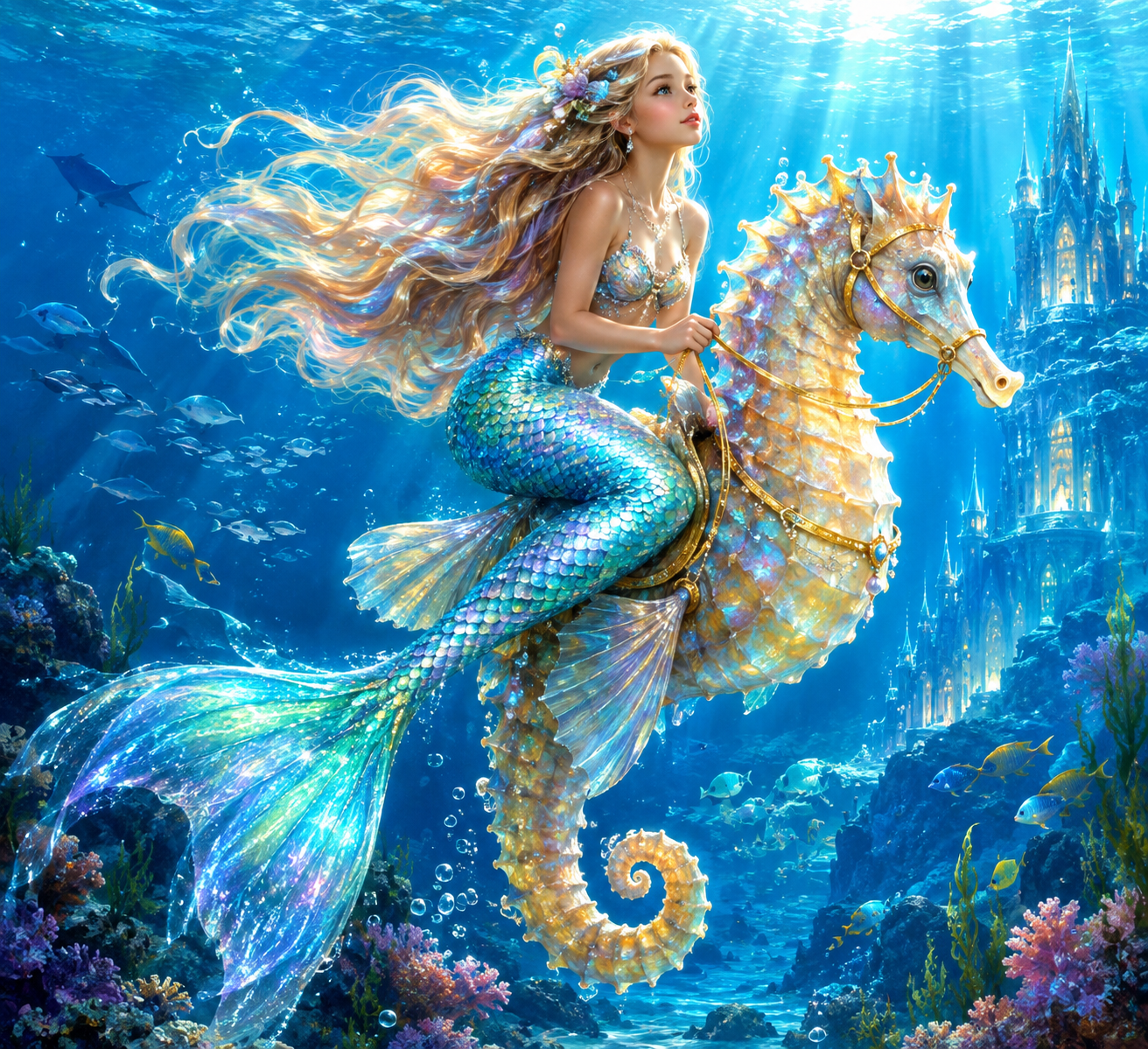
I was no longer just a girl.
I was a beautiful mermaid, with shimmering hair flowing like ribbons beneath the waves and a sparkling tail that glowed in the deep blue ocean.
In my dream, I was climbing gently onto seahorse back, holding its tiny golden reins as it carried me through an underwater kingdom.
Together, we raced past colorful coral gardens, sleepy turtles, dancing fish, and glowing jellyfish that looked like floating stars.
I felt free, weightless, and completely at home, kind of the same feeling nowadays when I enter the sea.
But in reality, the seahorse with its horse-like head, curled tail, and gentle way of moving through the water is one of those creatures that makes you stop and wonder how creative nature can be.
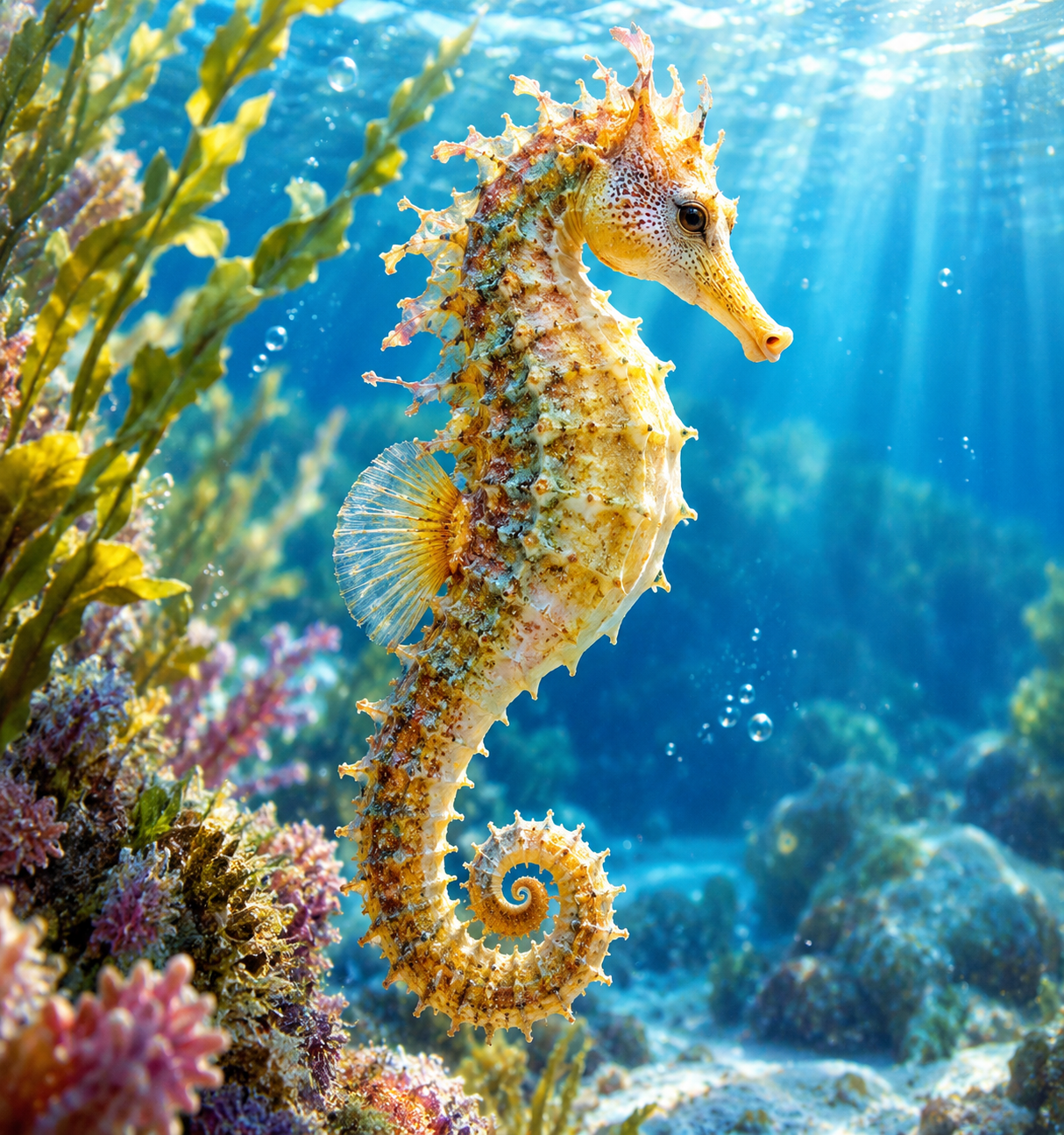
But behind its unusual appearance and my childhood fantasy is a fascinating life.
Seahorses are actually fish, even though they don’t look much like the fish we usually imagine.
They belong to the genus Hippocampus, a name that comes from ancient Greek words meaning “horse” and “sea monster.”
Unlike most fish, seahorses swim upright rather than horizontally. They use a small fin on their back to move forward and tiny fins near their head to help them steer.
They are not strong swimmers, so they often rely on their surroundings and their curled tails to hold onto seagrass, coral, or other underwater plants when currents become strong. It might take about 1 hour to travel just 16 meters, if it could keep that speed.
They have excellent eyesight. Each eye can move independently, similar to a chameleon’s eyes.
I find this especially interesting because it reminds me that being small or slow doesn’t necessarily mean being helpless. The seahorse has simply evolved a different way to survive. One of the most recognizable features of a seahorse is its long, curled tail. Unlike many fish, the seahorse has a prehensile tail, meaning it can use it to grip objects.
A seahorse might wrap its tail around a piece of seagrass and stay there while waiting for food or sheltering from the current. Some seahorses can even hold onto one another with their tails.
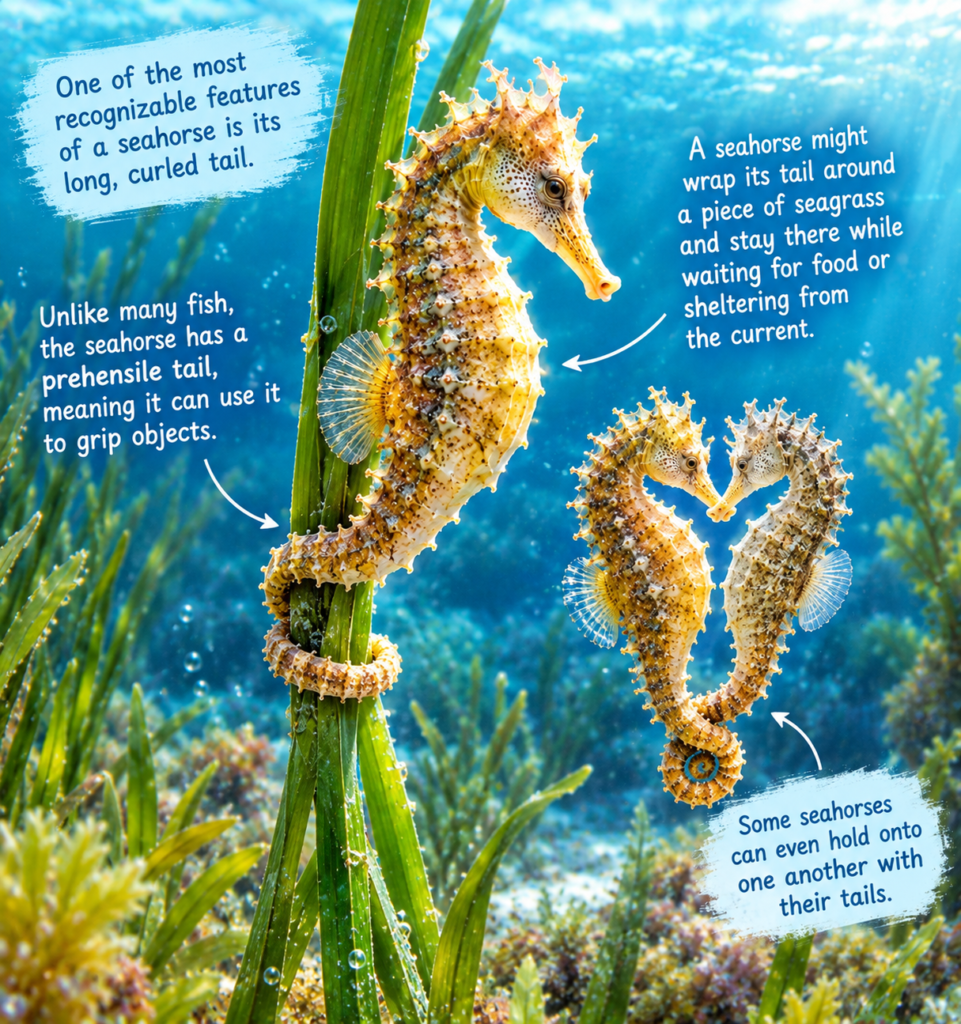
It’s a surprisingly practical feature for such a delicate looking animal.
Perhaps the most amazing fact about seahorses is that male seahorses become pregnant. During mating, the female transfers her eggs into a special pouch on the male’s abdomen.
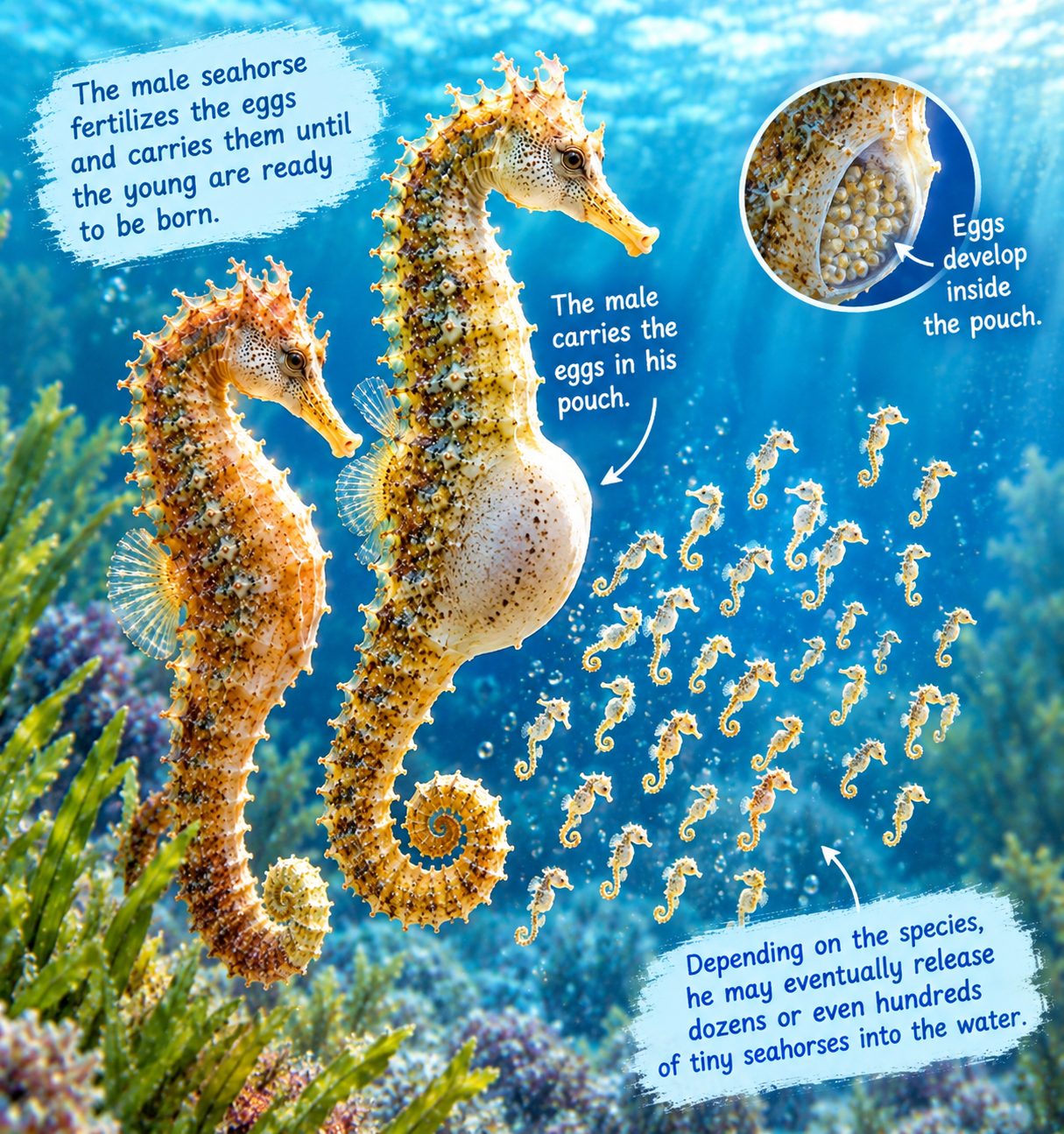
When I first learned this, it completely changed the way I thought about seahorses.
Nature has given them a reproductive system that is very different from what we normally see in the animal world.
Seahorses are predators, but they are not exactly frightening hunters. They mostly eat tiny animals such as small crustaceans and other planktonic organisms.
Because they don’t have a stomach, food passes through their digestive system quickly. This means they need to eat frequently. Sometimes, they consume many tiny prey items throughout the day.
They also have a fascinating feeding technique.
Instead of chasing their prey, they often remain still and use their long snout to suck food into their mouths with a quick movement.
Seahorses can blend into their surroundings remarkably well.
Depending on the species, they may change color or have body structures that help them resemble seagrass, coral, or other parts of their habitat.
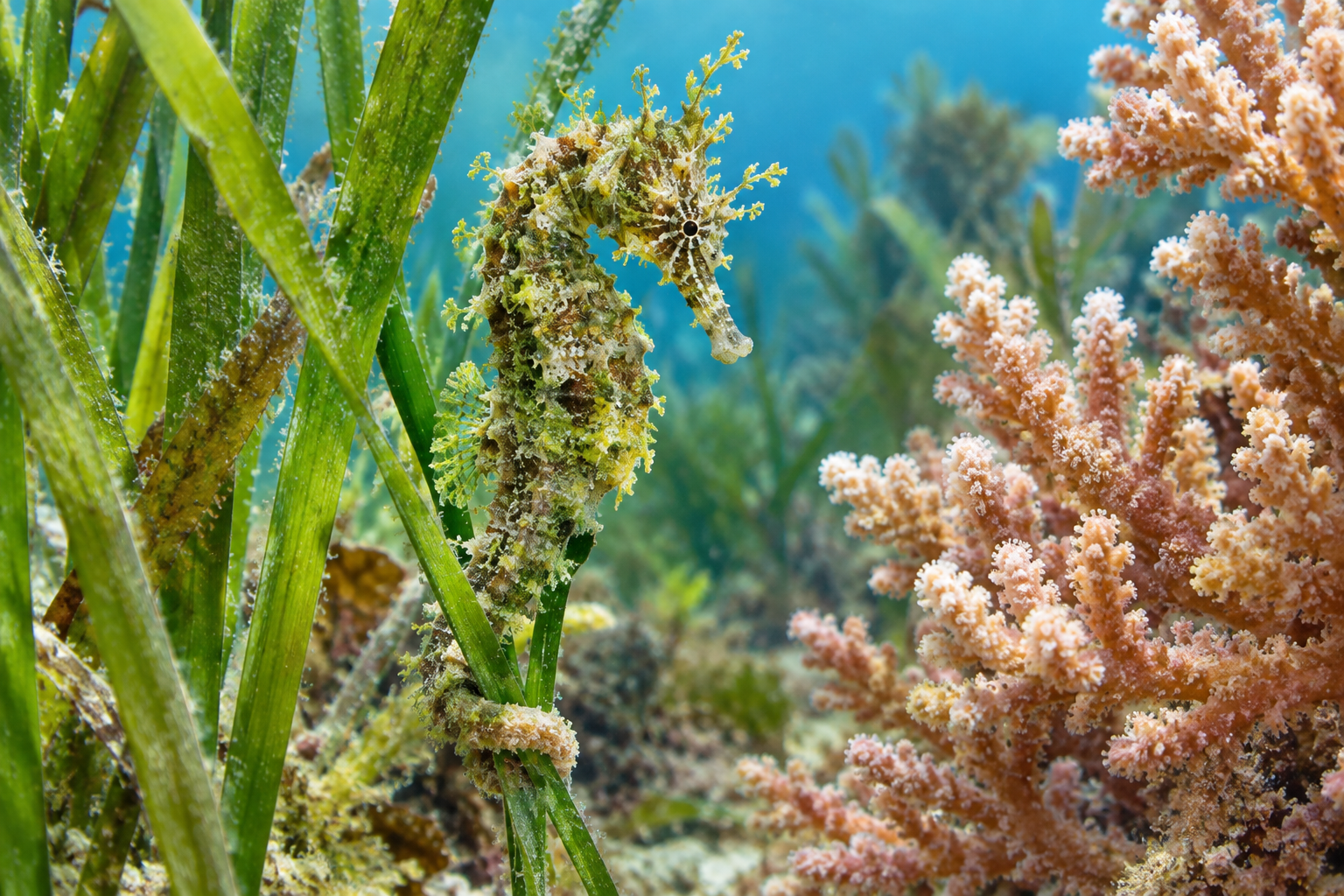
This camouflage helps protect them from predators and allows them to stay hidden while searching for food.
Looking at a seahorse makes me appreciate how survival isn’t always about strength. Sometimes, survival is about patience, adaptation, and knowing how to disappear into the background.
Nowdays, seahorses face many threats because the health of their populations depends heavily on healthy marine ecosystems. Destruction of seagrass beds, coral reefs, and mangrove habitats can reduce the places where they live and find food.
Pollution, accidental capture in fishing gear, and other human activities can also put pressure on seahorse populations.
Protecting seahorse, therefore, means protecting the larger underwater environments they call home.
Seahorses may be tiny, but their story is anything but small. They swim upright, hold onto plants with their tails, camouflage themselves, hunt tiny prey, and most famously male seahorses carry developing young.
What I love most about seahorses is that they challenge our expectations.
They show us that nature doesn’t have to follow the patterns we are familiar with. Perhaps that is the real lesson of the seahorse: there is more than one way to be remarkable.


Such a beautiful story about such a tiny, extraordinary creature. Nature never ceases to amaze me. 💙🌊 Keep telling these important stories!
Thank you so much for your comment!
Yet another fasinating and amazing article from Silvana. Also, what is extremely excellent, is the fact that mankind are adding to the survival of our oceans, seabeds and life that lives there, endangering them. I do question the constant use of cruise ships amongst this. Thank you also for the stunning illustrations. I really look forward to the next one.
Dear Nicola! Thank you very much for your comment 😀 Yes , cruise ships do not help much in this matter. However, we as a small digital community are trying to raise awareness about the importance of sea life and oceans as whole! Any word spreading and support is welcomed! Pls.share! totheoceans.com 🙂 🐋